
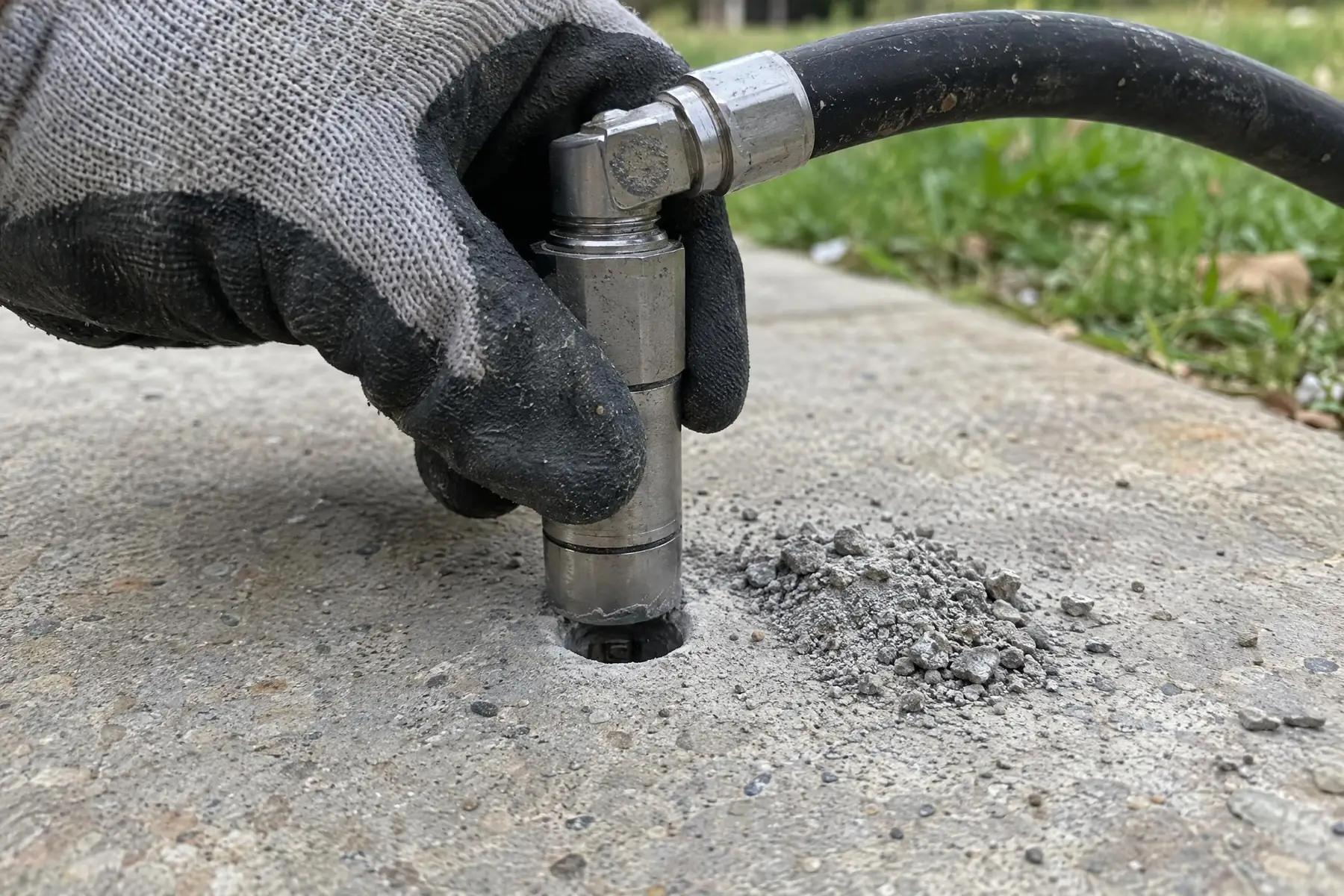
Polyjacking vs Mudjacking: How Each Lifts a Hollywood Slab
Polyjacking drills penny-size holes and injects liquid polyurethane foam under pressure. The foam expands, compacts the soil and raises the slab, and pressure gauges show when the base is firm. Mudjacking drills holes too, but it pumps a cement-based slurry under the slab. Slab jacking vs foam therefore comes down to what is pumped under the concrete.
The slurry works by weight and volume, and the foam works by expansion. Slurry fills the space it is pumped into and then stays put. A small amount of foam grows many times its liquid size and pushes into every gap it can reach. Foam is lighter, so it adds little load to soil that is already soft. Mudjacking needs larger holes, and the slurry has to dry before the slab is at full strength. Both methods need the crew to watch the slab rise, because over-lifting cracks the concrete. Gauges and a level guide the lift, and the crew stops when the surface is flush with the slab beside it. A crew that rushes either method risks cracking the concrete it is trying to save.
Both methods work when the slab is intact, so the choice turns on two things, and neither one replaces a careful estimate. The first is the ground under the slab, and the second is how soon you need the surface back. The next sections cover both, with the numbers for each, and the last section ties them to the surface you are fixing.